

The persistent drought experienced in the summer of 2025 significantly impacted the stability of building foundation walls, leading to cracks and deformations in the bricks. In fact, clay soils were the most vulnerable to drought.
Clay soil
Clay soil has a fine particle size and the unique characteristic of contracting and expanding due to changes in moisture content relative to its normal level. Clay typically forms the base of an underground aquifer, and when this aquifer dries up, often during an exceptionally hot and dry summer, the drying process can penetrate deeper into the clay layer, causing the clay soils to subside . This process is not entirely reversible, and once rehydrated, the soil, after contracting, does not usually return to its original volume.
Ground movements – which cause some problems in the construction sector during severe droughts – are primarily due to decreases in water content. More precisely, it is the differential settlement of the soil that causes these problems.
Clay soil beneath and around a building's foundations dries at different rates depending on the amount of water present and the soil depth. Several other factors also play a role . Areas where evaporation is limited do not dry quickly. However, outside the building's perimeter, the soil—directly exposed to evaporation—shrinks. This opposing force results in differential movement, leading to problems with the facades of buildings whose foundations are insufficiently deep or whose structure is not rigid enough. Voids appear between the foundations and the ground. Consequently, the building will tend to settle to fill these gaps.
Damage
The damage will be all the more serious if there are large trees near the foundations, whose roots draw water from the clay soil, and paved surfaces that prevent rainwater from replenishing the ground. Nearby infrastructure work can also cause soil settlement and foundation subsidence . Furthermore, the fact that differential settlement can reach several centimeters should not be overlooked.
We recently studied several structures where the foundation walls showed signs of recent movement. For this reason, the new owners decided to pursue legal action for latent defects.
Signs of movement in the building are numerous, including: 1) cracks in foundation walls; 2) shearing in brick cladding; 3) cracks in interior walls; 4) unevenness in floors; 5) deformations in door and window frames.
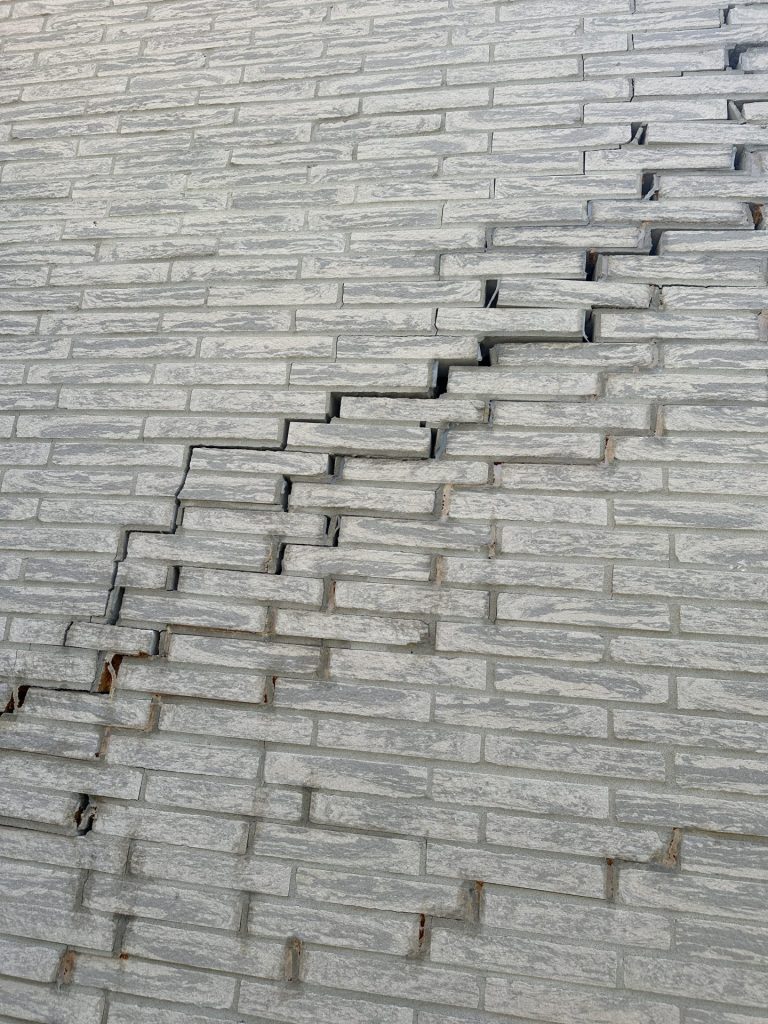
© Drought can cause cracks in foundation walls and fissures in bricks.

